Monday, February 20, 2012

IAR Reading Response 6: Humanism during the Renaissance

     Humanism was a school of thought that arose during the Renaissance period (14th to 17th century CE).  Its main focus was on rethinking human history from an objective standpoint rather than a religious one.  While it was not a religious movement, it did seek to reconcile this new view of history with the Christian faith.  Humanists emphasized both the greatness of the human race as a whole and the spirit of each individual human being.

     Until the advent of humanism, the large majority of the study of ancient texts was concerned with advancing and supplementing church doctrines.  Humanists were instead more interested in the actual words and ideas of the ancient philosophers than in how they could be used.  The biggest example of this would be Petrarch's climb of Mount Ventoux in 1336.  Saint Augustine had previously warned against taking too much pleasure from the senses, but Petrarch made his climb solely to enjoy the surrounding countryside.  This new-found appreciation for nature became one of the most important contributions of the humanists to the Renaissance, and this appreciation has made a long-lasting impression on many different fields of study, including architecture.

     The most profound effect that humanism had on society was that it made man the center of his universe.  The individual man was given greater emphasis, while still retaining the importance on mankind as a whole.  This sense of greatness and accomplishment led to a desire to reflect that feeling in their architecture.  The Renaissance, therefore, was in part a re-imagining of architecture and building design.

Image sources:
--http://www.humanetwork.org/about_humanism/about_humanism.htm
--http://www.humanismandculture.com/the-call-to-rediscover-humanism/
--http://www.life123.com/arts-culture/architecture-2/renaissance-architecture/european-renaissance-architecture.shtml

Tuesday, February 14, 2012

IAR 221: Unit I Summary

UNIT ONE: FOUNDATIONS
Week 1:  Object, space, building, place
Week 2:  Circles, groups/groves, stacks
Week 3:  Prototype, archetype, hybrid
Week 4:  Firmness, commodity, delight

     In 1970 a British mathematician named John Conway developed something called "The Game of Life."  The Game of Life is essentially a simulation, which requires only an initial input of data to operate.  From that input, four rules govern the progress of the simulation, and continue for as long as the rules allows.  The Game of Life is perhaps the most famous example of  how a simple set of rules, when applied to various situations, can create incredibly vast and complex works.

     I believe that this same idea--that simple rules can lead to complexity--applies to this first unit of the class.  Every week we were introduced to a new "set" of rules, which applied to things like scale (Week 1), organization (Week 2), development (Week 3), and perception (Week 4).  There were never more than 4 rules per set, so it is safe to say that these rules are fairly simple.  What we have seen during this unit however, in terms of architecture and various structures, has been incredibly diverse.  Underlying all this diversity has been these simple rules that we have learned during the first four weeks of the course.

     It is my opinion that the first unit in this course has introduced us to simple rules that, when applied by different people with varying ideas in unique situations, can and do result in an incredible amount of complexity in design.  Their simplicity makes them easy to remember, which in turn allows us to break down seemingly overcomplicated structures into manageable parts.  These rules allow us to analyze every single structure we have seen and will see, both over the length of the course and in our day-to-day lives.  While there are in fact other circumstances that we must consider when analyzing buildings (things such as political climate, physical environment, and values of the builders), the rules we have been introduced to in Unit I will be invaluable resources when analyzing structures on a deeper level. 

Monday, February 13, 2012

IAR RR 5: The Rise of Islam and Its Effect on the Middle East

     As the second-largest and one of the fastest growing religions in the world, Islam is a powerful force in today's society.  It has 1.5 billion followers (22% of the world's population) in almost every country on Earth.  Because it is so dominant in the modern world, it has affected many different aspects of everyday life.  This impact is not a new development in Islam:  the religion has a rich history going all the way back to its origins during the 6th century CE.


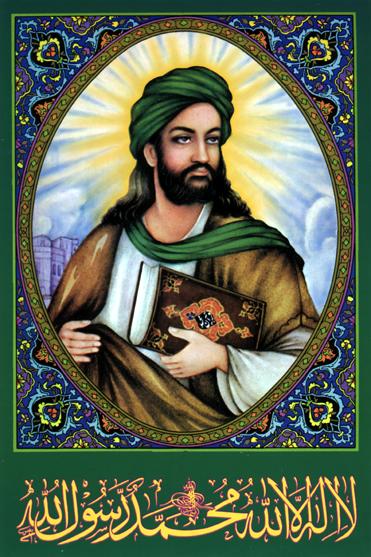
     Islam was founded by a man named Muhammad, who was born in Mecca in 570 CE.  When he was forty years old, he received his first vision, and shortly thereafter began preaching monotheism.  Because the large majority of the Middle East were polytheists, his message was opposed by many.  But for as many people who opposed his teachings, there were just as many who listened to and followed him.  He warred against many Arab tribes, but was eventually successful in conquering Mecca and making it the center of the Islam faith.  He died in 632 CE, but even after his death Muslims were continuing to unite the Middle East, until Islam was the largest political entity in the West.

     The most prominent effect Islam has had on the world--specifically, the world of design and architecture--is the creation of the mosque.  Because Islam's origins lay in the Middle East, away from Greece and its architecture, the structure of the mosque is entirely different from that of the Christian church (which has its roots in Greek architecture).  It too has a rectangular shape; however, the mosque is constructed around its orientation to the city of Mecca, with a qibla wall standing at a right angle to a line towards Mecca.  It is this wall that Muslims face during sermons.  A standard mosque also includes a courtyard at the entrance, and a fountain used for washing the body.  While mosques and churches are similar (rectangular shape, courtyards, etc), the circumstances surrounding their origins have shaped them very differently overall. 

THINGS TO REMEMBER:
--Since its origination in the 6th CE, Islam has become one of the largest and most influential forces on the planet, with nearly a quarter of the world's population adhering to its tenets.
--Because Muhammad died without leaving instructions for a successor, Islam split over how his territory should be ruled.  This divide exists even to this day.
--While a building of worship is not required in Islam, the mosque has evolved as a center of worship for Muslims.  Because Islam originated in the Middle East and not the West (where Greek-inspired architecture is the norm), the mosque and the Christian church are designed very differently and reflect differences in the two faiths.

IMAGE SOURCES:
--https://blogger.googleusercontent.com/img/b/R29vZ2xl/AVvXsEhropOq5iUDuAmf9DGQLSAH4LTIZ7ow9ogu94wQ9Feu0lbT6LG_MPvbaLUvWiWMCjnEn_z2nbUPp0q87pXK9pbZZtcnMkbfLzgUaN27uEfd1jMN1oWkx_UtLFtFqOZ8j8Av7qn8AG3uudc/s1600/Muslims-praying-.jpg
--http://www.proprofs.com/flashcards/upload/q8793112.jpg
--http://americanvision.org/wp-content/uploads/2010/12/Dome_of_Rock.jpg

Monday, February 6, 2012

IAR RR 4: The Hagia Sophia as a Monument to Justinian

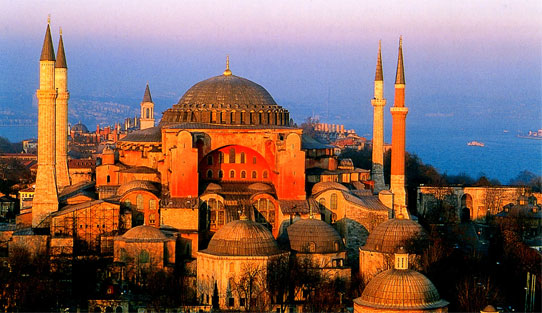
     Little is known about the original Hagia Sophia, as it was damaged during the reign of Emperor Justinian.  What is known, however, is that it has always been one of the most impressive structures in Western architecture.  Emperor Justinian decided that its reconstruction would serve as a monument to his victory over the rebellion of 532 CE.  And, because this would be a lasting symbol of his triumph, he made sure it would be a structure unlike any other.  Even to this day, this holds true--the Hagia Sophia is one of the most unique and awe-inspiring buildings in the world.


     To make sure that the Hagia Sophia was an unrivaled marvel of architecture, he employed two philosophers--Anthemios and Isidoros, famous for their work in theoretical geometry--to concieve of plans for the new church.  The result was a centralized and axial building unlike anything that had been seen before.  It was topped with a golden dome, which also had to be rebuilt after an earthquake in 557 CE.  The interior was decorated with multiple mosaics made of marble from throughout the Byzantine Empire.  It also made use of recycled materials from non-Christian temples; this was a common building practice of the day, but it was also a symbolic domination of the old "pagan" religions.

     The Hagia Sophia is both a physical and symbolic representation of Justinian's triumphant rule.  As a building, it is unmatched anywhere in the world, ancient or modern.  It is also a strongly symbolic representation of Christianity over the old ways, and of the beginnings of the union of church and state (in this case, the Byzantine Empire). 

Things to Remember:
--  Dedicated by Constantine in 360 CE, but damaged during uprisings in 532 CE.
--  Designed not by master builders, but by two philosophers who were experts in theoretical physics and geometry.
--  Seen as a physical representation of the universe:  the cube (earth) topped by the dome (heaven).

Image Sources:
--http://www.sacred-destinations.com/turkey/istanbul-hagia-sophia
--http://outlookturkey.com/archives/tag/hagia-sophia
--http://www.teslasociety.com/hagiasophia.htm

Monday, January 30, 2012

Blog Post 3: Xianyang and the Acropolis


     I believe that, while there are similarities between the Xianyang Palace and the Acropolis, they are more different than they are alike.  This conclusion is evident when looking at three different aspects:  the building's purpose, how the building was seen by the common people, and the building itself.

     The Xianyang palace was built as that--a palace.  It was meant to be a representation of the emperor's power and influence; this is reflected in the fact that the palace's rooms was filled with wealth.  It is also apparent in the so-called "Terracotta Army" that stands below the palace.  This army faces south, where the emperor's enemies would have been located when the palace was built.  These two facts--the wealth-filled rooms and the "army"--indicate that the palace was meant to intimidate.  The Acropolis, however, was not intimidating but inviting.  It was a place of worship, built not for any emperor but for the Greek gods themselves.  The Acropolis was a welcoming place, meant more for the Athenians themselves than for any outsider.

     In the same way, the Acropolis was revered by its own people, but in its approachability.  Every four years a massive procession involving all Athenians made its way to the Acropolis, where there was a great festival to the gods.  Despite its size, the Athenians did not fear the Acropolis.  On the other hand, the Xianyang palace was only used by the emperor and his staff--common people had no reason to ever enter it.  Its reverence stemmed from its "untouchability," its distance from the everyday man.

     Finally, the buildings themselves are two completely different structures.  The Acropolis is very open dotted with buildings, each of which was constructed by a different person at a different time for a different purpose.  The Xianyang palace is not like this at all--it is one large building, built at one time and overseen by one person, for the purpose of serving the emperor's needs.  Thus, it is obvious to even the most casual observer that, while both structures are impressive, they are polar opposites of one another.

Reading Response 3: The Colosseum as a Symbol of Rome

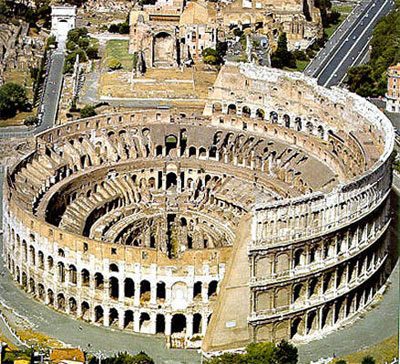
       The Colosseum represents one of the most perfectly planned, supervised, and constructed buildings in history.  Despite being built in the first century C.E., it still remains largely intact, and might still be complete if it weren't for earthquakes in 1231 and 1349.  It was a powerful cultural symbol of the Roman Empire during its height, and even today remains one of the most easily recognizable structures in the world. 

     The Colosseum, while not the first theater to be built in Rome, was in fact the first theater built as a freestanding object.  It could hold fifty thousand spectators, who would gather to watch various events.  The large capacity was possible because of the Roman's innovative idea to combine two smaller, half-circle theaters to form one large oval-shaped space that could host multiple events.  The Colosseum is most famous for hosting gladitorial fights, but it also hosted the exhibitions of wild animals, a variety of games,and public punishments.  The skill and precision that went into the Colosseum's construction is apparent in multiple aspects of the historical and modern record.

     The name of the Colosseum's chief architect is now unknown, but he must have been very famous in his day.  This is because the Colosseum was being constructed by multiple work crews in several areas and over a long span of time--it would take a master architect and supervisor to successfully coordinate such an effort.  The Colosseum itself is an incredible structure, both in size and in detail.  It is divided into four stories:  the first three each utilize a specific style of column (Doric, Ionic, or Corinthian), while the fourth is adorned with brackets that allowed for awnings to be stretched over the audience.  However, while these columns seem to be more ornamental than structural in purpose, the truth is in fact the opposite.  The columns bear much more weight than is immediately obvious, while the vaults bear much less.  This is an incredibly risky, yet ultimately powerful, construction choice that helps make the Colosseum that much more impressive.

Some final thoughts:
--  Built in 80 C.E. and remains standing, a clear indicator of well-planned and executed construction.
--  Host to many different events, the last of which (public punishments) was not ended until the 8th century.
--  An awe-inspiring structure that perfectly balances function and beauty, the Colosseum remains an impressive cultural icon.

Image sources:
--http://www.sacred-destinations.com/italy/rome-colosseum
--http://www.legionxxiv.org/colosseum/
--http://www.aboutroma.com/colosseum.html